

Key takeaways
- Link building remains one of the three fundamental pillars of SEO in 2026
- Every inbound link acts as a vote of confidence in Google's eyes
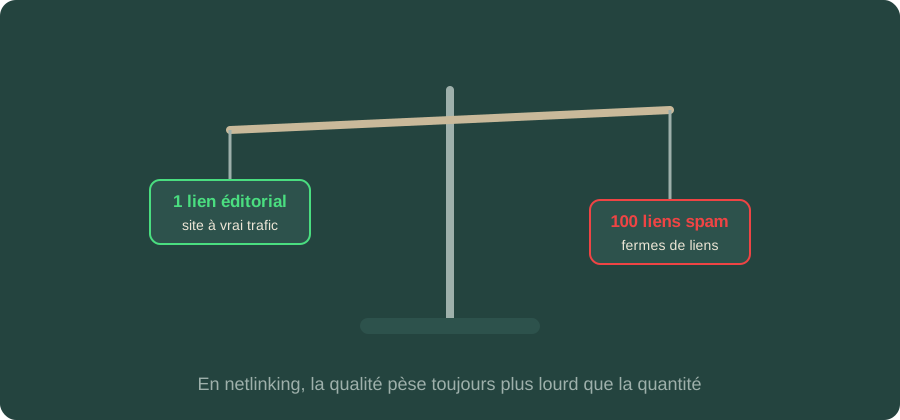
- Quality beats quantity: one good editorial link is worth more than ten mediocre ones
- Artificial tactics (link farms, PBNs) expose you to severe penalties
- A natural link profile is built gradually, with varied anchor texts
Why do links matter so much to Google?
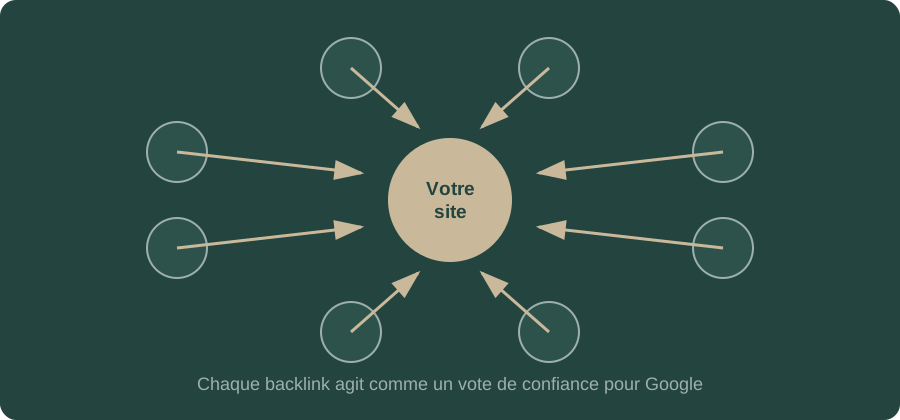
Google built its original algorithm (PageRank) on a simple principle: a site that receives many links from other quality sites is probably trustworthy.
Twenty-five years later, this principle still holds, though it’s become far more sophisticated. Google now analyzes:
- The quality of the sites linking to you (not just how many)
- The topical relevance of the referring sites (relevance matters as much as authority)
- The context of the link on the page (editorial mention vs. a list of links)
- The anchor text used (the clickable text of the link)
- The diversity of the link profile (natural link profile)
The different types of links
Editorial links
These are the most valuable. An editorial link is earned when another site finds your content interesting enough to cite it naturally. They’re hard to get but durable and powerful.
Partnership links
Visibility exchanges with complementary (non-competing) sites. Use sparingly and only with quality sites.
Guest blogging links
You write an article for a third-party site and get a link in return. A legitimate practice as long as the content is high-quality and the host site is reputable.
What to avoid at all costs
- Link farms: sites created solely to sell links
- PBNs (Private Blog Networks): artificial site networks
- Mass link exchanges: Google detects these easily
- Footer or bottom-of-page links: low value, sometimes penalized
How do you choose your link sources?
The quality of a link depends on several combined criteria:
1. Domain authority (DR/DA)
Domain Rating (Ahrefs) or Domain Authority (Moz) gives an indication of a site’s strength. Aim for sites with a DR above 30, ideally above 50.
Careful: DR alone isn’t enough. A site with a DR of 80 but no real traffic won’t help you.
2. Real organic traffic
A site that ranks on Google has genuine editorial presence. Check that it generates organic traffic in Ahrefs or SEMrush. A site with zero organic visitors is suspicious.
3. Topical relevance
A link from a site in the same niche is worth 5 to 10x more than an off-topic link. If you’re in fashion e-commerce, a link from a lifestyle or fashion blog is worth infinitely more than one from a gardening site.
4. Placement on the page
- Link within the body of an article: excellent
- Link in the sidebar: average
- Link in the footer: low value
5. Editorial quality of the site
Does the site publish content regularly? Does it have a real audience? Is it properly moderated? These signals tell Google whether it can consider the site a reliable source.
Anchor text strategy: a balance you can’t afford to get wrong
The anchor is the clickable text of your link. Its composition is crucial.
A natural anchor text profile looks like this:
| Anchor type | Example | Recommended share |
|---|---|---|
| Branded | ”Transiflow” | 30-40% |
| Naked URL | ”transiflow.com” | 15-20% |
| Generic | ”click here”, “learn more” | 20-25% |
| Partial match | ”SEO agency” | 15-20% |
| Exact match | ”SEO agency Paris” | 5-10% max |
Too many exact-match anchors = an artificial signal = risk of penalty.
How many links do you need to rank?
There’s no universal answer, but a simple rule: look at what the top 3 results are doing for your target keyword.
If the #1 result has 50 referring domains pointing to that page, you need a comparable number, of equivalent quality. If you have 5 links and your competitor has 500, you know what’s left to do.
Link building in practice: how do you actually earn links?
Quality guest blogging
Identify blogs in your industry that accept outside contributions. Pitch a high-quality article that offers real value to their audience. Don’t chase the link alone: aim to deliver value.
The “linkable asset” method
Create resources so thorough and so unique that they naturally deserve to be cited: comprehensive guides, original studies, free tools, infographics, compiled statistics. Bonus: this kind of content is also what AI models like to cite.
Editorial partnerships
Partnerships with media outlets, professional associations, training organizations, or complementary service providers for relevant mutual mentions.
Link building platforms
To speed up acquisition, specialized platforms connect advertisers with site publishers. The best-known names on the French market: Ereferer, Linkavista, and Linkuma. They let you buy links on sites filtered by topic, authority, and traffic.
That said, the platform is just a tool. What actually makes the difference between link building that builds authority and link building that triggers a penalty is site selection (real traffic, consistent topic, clean history) and the pace of acquisition.
Digital PR
Press releases, contributed feature articles, expert interviews: all opportunities to earn links from high-authority media outlets.
Monitoring and protecting your link profile
Audit regularly
Every 3 to 6 months, analyze your link profile in Ahrefs or Google Search Console. Watch for toxic links appearing (spam, adult sites, gambling sites).
Disavow harmful links
If you spot clearly toxic links (especially if you’ve received a manual penalty), use Google Search Console’s disavow tool to neutralize them.
Track your authority over time
Chart your DR month over month. Steady growth is a good sign. Stagnation despite your efforts suggests your links are low quality or that your competitors are progressing faster.
Conclusion
Link building is foundational work, not a shortcut. Links that last, that protect your site from Google updates, and that generate real results come from quality, patience, and rigor.
Avoid cut-rate offers (“100 links for €50”) that expose your site to a potentially irreversible penalty. Invest in quality editorial links: it’s slower, but it’s what builds real authority.
Want to hand off your link building strategy to us? Discover our SEO link building service and get a free analysis of your current link profile.