

✓ AI doesn't replace a copywriter: it excels at research, briefs, and first drafts, but fails at real experience and E-E-A-T.
✓ Google doesn't penalize AI content in itself: it penalizes low-quality content, whether human or generated.
✓ 100% generated content eventually crashes: a few weeks of growth, then a traffic drop.
✓ SEO copywriting with AI = copiloting: AI produces the structure, humans bring proof, examples, and expertise.
✓ One pair is enough: a semantic tool + a generative AI cover 90% of needs for under €50 a month.
✓ 1-minute quiz further down to choose your approach based on your situation.
What Can AI Actually Do for SEO Copywriting?
AI for SEO copywriting refers to the use of generative models like ChatGPT, Claude, or Mistral, combined with semantic optimization tools, to prepare, write, and optimize content for organic search. According to BrightEdge, more than 80% of marketers already use at least one AI-based SEO tool.
But be careful with the promise: AI isn’t good at everything. It shines on analysis and structuring tasks, and it falls short the moment real experience is required. That’s exactly what separates content that ranks from content that stalls. Before you write, you also need to know what to target: solid keyword research remains the starting point for any content, AI-assisted or not.
| SEO Copywriting Task | AI Alone | Why |
|---|---|---|
| SERP and competitor analysis | ✅ Excellent | Summarizes dozens of pages in minutes |
| Outline and semantic brief | ✅ Very good | Structure and vocabulary well covered |
| First draft of an article | 🟡 Fair | Fluent but generic, needs enrichment |
| Real experience, case studies, figures | ❌ Poor | It doesn’t know your business, it invents |
| E-E-A-T and trust signals | ❌ Poor | Demonstrated expertise can’t be generated |
AI is a production accelerator, not a source of expertise. Traffic from AI recommendations converts at up to 15.9%, compared with 1.76% for standard Google traffic: content cited by AI is worth a lot, and it's precisely the content with strong human added value that gets cited.
Does Google Penalize AI-Written Content?
Google’s official position has been clear since 2023: the search engine does not penalize the use of AI in itself. It rewards useful, original content and penalizes low-quality content, regardless of its source. The deciding factor is called E-E-A-T: experience, expertise, authoritativeness, trustworthiness.
In practice, the pattern seen on sites that publish 100% generated content is almost always the same: a rise in visibility for a few weeks, while Google evaluates the content, followed by a sometimes brutal drop. The texts all look alike, add nothing new, and behavioral signals eventually sink them: quick returns to the SERP (the infamous pogo-sticking measured by systems like NavBoost), low time on page, and no satisfaction clicks.
If your traffic has already dropped after a phase of mass publishing, an SEO audit can pinpoint exactly which pages to rework first.
Which AI Approach Fits Your SEO Copywriting? Take the Test
Copilot it yourself, delegate the writing, or hand over the whole strategy: the right answer depends on your content volume, the expertise you have in-house, and your budget. Answer these 4 questions to get our recommendation.
Find your AI approach to SEO copywriting in 1 minute
4 questions, instant recommendation
Question 1 of 4
What AI Tools Should You Use for SEO Copywriting?
AI tools for SEO copywriting fall into three families: generative AI (ChatGPT, Claude, Mistral), which produces the text, semantic optimization tools (YourTextGuru, Surfer SEO), which show what to cover for a keyword, and monitoring engines like Perplexity. Combining the first two families covers 90% of the work. To compare the models against each other, check our comparison: which AI writes best.
| Tool | Strength | Ideal Use | Indicative Price |
|---|---|---|---|
| ChatGPT | Versatility, ecosystem | First drafts, briefs, meta tags | $20/month |
| Claude | Long document analysis | Semantic audit, optimization | $20/month |
| Mistral | French, GDPR, API cost | High-volume production | €15/month |
| YourTextGuru | French semantic scoring | Content optimization | ~€4/guide |
| Surfer SEO | On-page optimization | Scoring vs. competitors | $89/month |
| Perplexity | Real-time sourced research | Monitoring, SERP analysis | Free / $20 |
The figures in this table are indicative and may vary depending on the provider, region, and specifics of your project. For an accurate quote, request a personalized estimate.
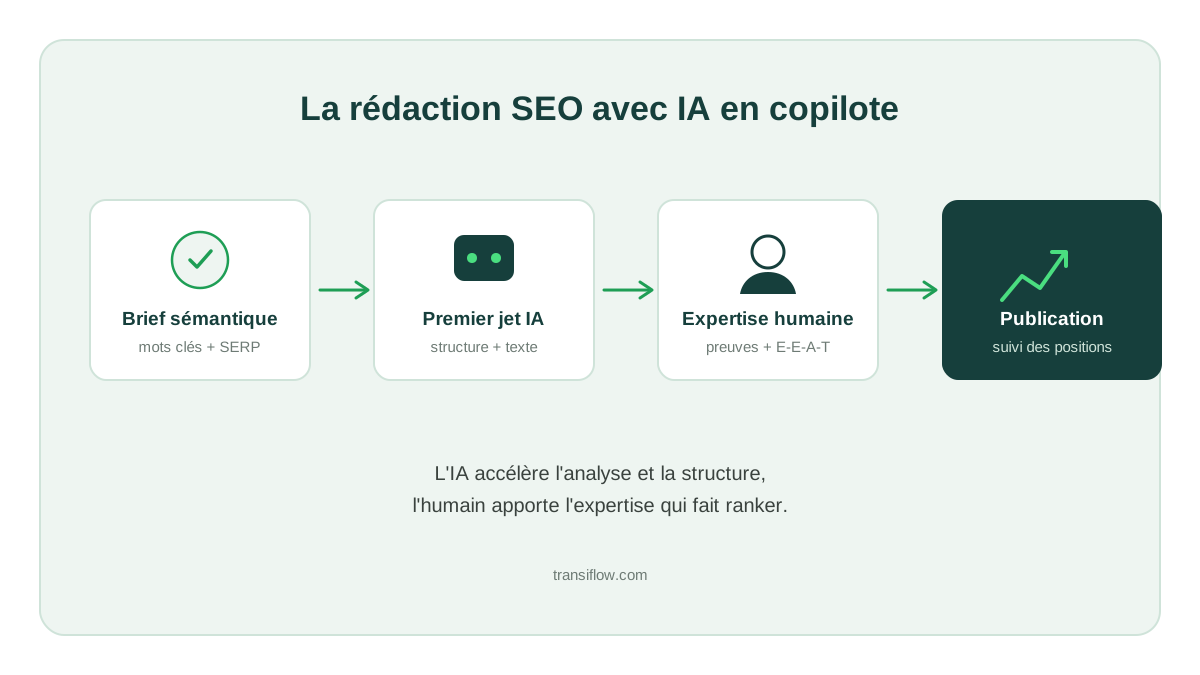
The Copilot Method: SEO Copywriting with AI in 5 Steps
Here’s the process we apply: AI speeds up every step, while the human keeps the final call and adds what AI simply cannot invent.
1. Define the target. Keyword research, real SERP analysis, and search intent. AI summarizes competitor pages, tools supply the data.
2. Build the semantic brief. Expected vocabulary (YourTextGuru), frequently asked questions, a differentiating angle versus the top 5. This is the safeguard against generic content.
3. Generate a structured first draft. A detailed prompt: topic, heading outline, keywords to include, tone, length. The more precise the prompt, the lighter the rewrite.
4. Enrich with human input. Customer data, concrete examples, field feedback, strong opinions: everything that builds E-E-A-T and that no competitor can copy. This is the step that makes content rank. To understand the fundamentals that make this enrichment effective, revisit what SEO is and its quality criteria.
5. Review before publishing. Systematic fact-checking (AI makes up numbers), semantic verification, internal linking, metadata. Then track your rankings.
If your content needs to drive revenue, don't bet everything on generation: our content stays written by humans, with AI used purely as an analysis accelerator. And if you want the complete engine (strategy, content, link building, reporting), that's what our monthly SEO retainer is for.
Request my free SEO audit
The Mistakes That Wreck Your SEO with AI
Five traps come up again and again among sites that come to us after a traffic drop:
- Publishing without proofreading: sloppy mistakes, repetition, and made-up facts go live.
- Over-optimizing: mechanically chasing a semantic score produces artificial text that Google spots.
- Ignoring search intent: a good optimization score can’t save off-topic content.
- Making every page look the same: identical structures, transitions, and generic tone across 50 articles.
- Neglecting technical SEO: even the best content won’t rank on a slow or poorly linked site.
FAQ - AI for SEO Copywriting: Your Common Questions
Does Google penalize AI-generated content?
No, not as such. Google evaluates quality, originality, and usefulness, regardless of the content’s source. That said, mass-generated content with no added value is treated as spam and eventually demoted.
Can ChatGPT replace an SEO copywriter?
No. ChatGPT produces decent but generic first drafts. It has no field experience, no customer data, and no opinions: the E-E-A-T ingredients that make content rank long-term remain human.
What are the best AI tools for SEO copywriting?
The most effective combo pairs a generative AI (ChatGPT or Claude, around $20/month) with a semantic optimization tool like YourTextGuru or Surfer SEO. Perplexity rounds it out for monitoring and real-time SERP analysis.
How do you write a good prompt for an SEO article?
Specify the topic and target keyword, the expected outline (H2/H3), the secondary keywords to include, the tone, the length, and the output format. A vague prompt produces generic text; a structured prompt cuts rewriting in half.
How do you write SEO-friendly content with AI?
Give the AI a complete brief: target keyword, heading outline, expected semantic field, and search intent. The generated content only becomes truly SEO-friendly after human enrichment: concrete examples, verified data, internal linking, and optimized metadata.
How much does AI-assisted SEO copywriting cost?
In-house, budget €30 to €60 a month in tools (generative AI + semantic optimization). When delegating to an agency, AI-assisted human SEO copywriting starts around a few hundred euros a month depending on volume.
Can AI help my site get cited by ChatGPT?
Indirectly, yes. Getting cited by AI is what GEO (Generative Engine Optimization) is about: structured, factual, well-sourced content that models can extract. Content enriched with real expertise has a much better chance of being picked up as a source.